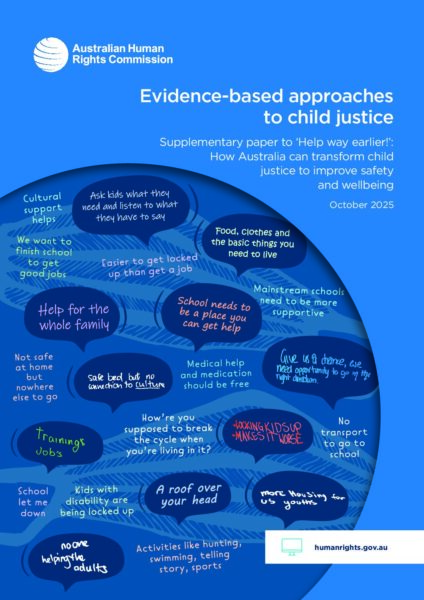
2025 ‘Help Way Earlier!’ Supplementary Report. How Australia can learn from global approaches to child and youth justice reform
Last updated: 03 Nov 2025
A new supplement to the Australian Human Rights Commission’s 2024 ‘Help Way Earlier!’ report explores opportunities to reform Australia’s child and youth justice system. The 2025 report presents six case studies from Australia and around the world, highlighting evidence-based approaches that prioritise early intervention, community partnership, and system-wide reform. It finds that punitive measures such as detention are often harmful and ineffective, and identifies strategies that can better support children’s safety, wellbeing, and long-term outcomes.
More resources in this category
-
File
Generation Trapped. Housing, handouts, and the collapse of young Australians’ life satisfaction
This CIS paper examines the lives, aspirations, values, and perceived barriers of Australians aged 18–34.
- Children and Young People's Wellbeing
-
External Link
Lived experiences of First Nations children in Therapeutic Residential Care
This qualitative study in Child Abuse & Neglect examines the lived experiences of First Nations young people in Therapeutic Residential Care across New South Wales. Drawing on interviews with sixteen participants and using thematic analysis informed by Critical Race Theory, the research centres young people as knowledge‑holders. They identified enablers of wellbeing such as stable relationships, cultural affirmation and opportunities for autonomy, and highlighted constraints including frequent relocations, disempowering routines and cultural disconnection. Systemic racism and the need for cultural safety were strong themes. The authors argue that structural reform grounded in Indigenous perspectives is essential to creating empowering care…
- Children and Young People's Wellbeing
-
External Link
How do social media use, gaming frequency, and internalizing symptoms predict each other overtime in early-to-middle adolescence
This longitudinal study from the Journal of Public Health looks at how social media use, gaming and internalising symptoms influence each other during early to middle adolescence. Using a large cohort of more than 25 000 young people in Greater Manchester, the authors found that gender‑specific patterns, such as girls’ gaming predicted reduced social media use, but no evidence that social media or gaming caused later internalising symptoms. The authors conclude that digital technology use is unlikely to be a major causal driver of adolescent mental health difficulties.
- Children and Young People's Wellbeing
-
External Link
Hearing the voice of the baby through participatory arts: Enriching the Lundy Model of Participation
This qualitative study in The International Journal of Children’s Rights investigates how participatory arts can support babies’ rights to be heard, drawing on observations analysed through reflexive thematic analysis. The researchers produced a Reflective Guide to enrich the Lundy Model of Participation, addressing long‑standing gaps in research and practice around babies’ participation rights. Their findings highlight tensions in adult–child relationality and offer a resource tailored to a group often overlooked in participation work. The authors recommend further empirical research, evaluation of the guide in diverse contexts, and exploration of similar tools for non‑verbal older children and young people.
- Children and Young People's Wellbeing