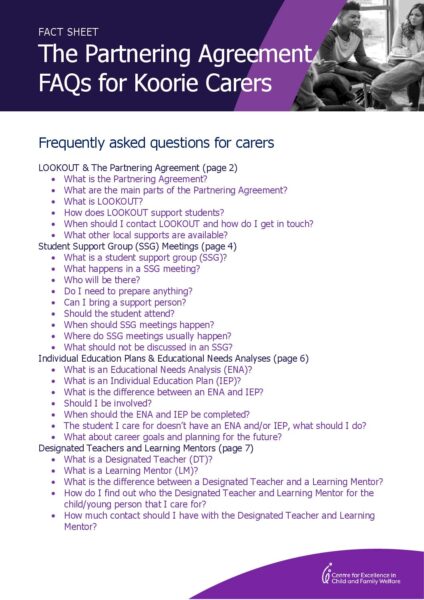
Partnering Agreement Fact Sheet – FAQs for Koorie Carers
Last updated: 11 Sep 2025
This fact sheet summarises the core elements of the Partnering Agreement and answers common questions in one document. It was put together by a Department of Education Koorie staff member and may be helpful for Koorie carers.
This fact sheet summarises the core elements of the Partnering Agreement and answers common questions in one document. It was put together by a Department of Education Koorie staff member and may be helpful for Koorie carers.
LOOKOUT & The Partnering Agreement (page 2)
• What is the Partnering Agreement?
• What are the main parts of the Partnering Agreement?
• What is LOOKOUT?
• How does LOOKOUT support students?
• When should I contact LOOKOUT and how do I get in touch?
• What other local supports are available?
Student Support Group (SSG) Meetings (page 4)
• What is a student support group (SSG)?
• What happens in a SSG meeting?
• Who will be there?
• Do I need to prepare anything?
• Can I bring a support person?
• Should the student attend?
• When should SSG meetings happen?
• Where do SSG meetings usually happen?
• What should not be discussed in an SSG?
Individual Education Plans & Educational Needs Analyses (page 6)
• What is an Educational Needs Analysis (ENA)?
• What is an Individual Education Plan (IEP)?
• What is the difference between an ENA and IEP?
• Should I be involved?
• When should the ENA and IEP be completed?
• The student I care for doesn’t have an ENA and/or IEP, what should I do?
• What about career goals and planning for the future?
Designated Teachers and Learning Mentors (page 7)
• What is a Designated Teacher (DT)?
• What is a Learning Mentor (LM)?
• What is the difference between a Designated Teacher and a Learning Mentor?
• How do I find out who the Designated Teacher and Learning Mentor for the
child/young person that I care for?
• How much contact should I have with the Designated Teacher and Learning
Mentor
More resources in this category
-
Video
Sector Buzz: The Podcast │ Ep.1: Building Culturally Safe Support for Young People
At this year's Family Services Symposium: Together with families, Jo Stanley interviewed Ridmi, Rianne and Mahsa, three Shout-out speakers from the Centre for Multicultural Youth, and young advocates with lived-experience of family services. In this episode, they share valuable insights on the family services system through an intersectional lens and explore the importance of culturally responsive practice when supporting children, young people and families.
- For Professionals
-
File
A guide to navigating racism in out-of-home care
This guide was developed by MacKillop Family Services, in collaboration with the Centre for Multicultural Youth, to support workers, carers and leaders in out‑of‑home care (OoHC) to recognise, respond to, record and repair incidents of racism and other identity‑based harm in ways that are trauma‑aware, culturally safe and rights‑affirming.
-
File
Multicultural Advisor support guide
This guide has been developed by MacKillop Family Services, in collaboration with the Centre for Multicultural Youth, as part of the Building Multicultural Practice in OoHC project. It aims to build a shared understanding of the Multicultural Advisor role, provide guidance on common challenges, and offer strategies and reflection prompts to support your practice.
-
File
Multicultural Cultural Support Plan: Practice Guide
This guide has been developed by MacKillop Family Services, in collaboration with the Centre for Multicultural Youth, to help staff complete a Multicultural Support Plan for multicultural children and young people engaged with MacKillop Family Services.